

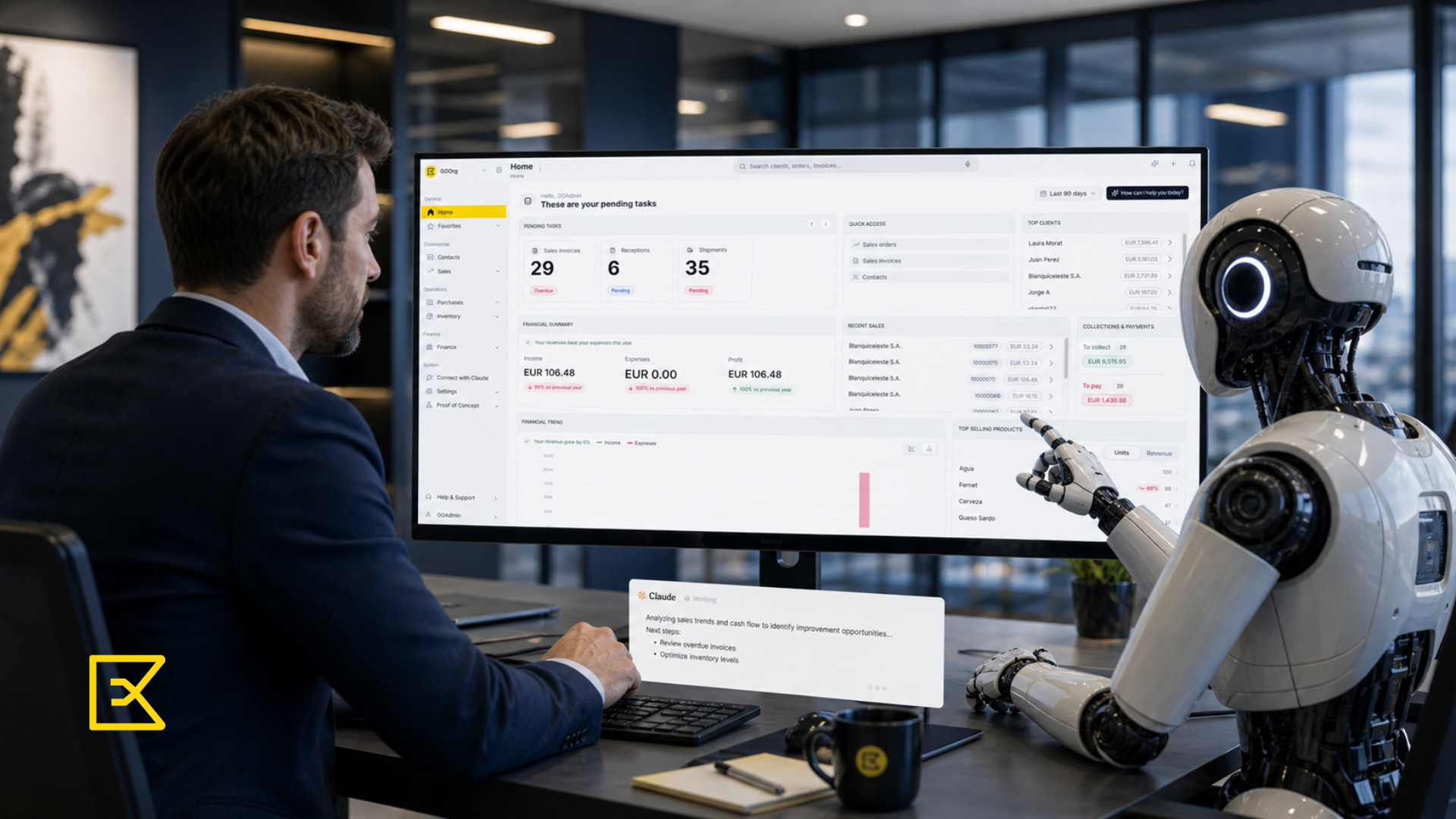
The agentic ERP your business needs
The way teams work is about to change — and the agentic ERP is the core piece of that shift. This is not a hypothesis or a distant trend: it is the logical next step of the paradigm that AI already set in motion. For any business, the question is not whether agents will work alongside employees, but when — and whether the software they use today will be ready when that moment comes.
An agentic ERP is not a better version of the traditional ERP. It is a change of paradigm. Companies that understand that difference early enough will build an advantage that will be very hard for competitors to close later.
The end of the ERP as a giant form
For decades, the ERP has been a fundamentally passive tool.
It waits. It waits for someone to open a screen, enter data, launch a process, generate a report. The system holds all the information about the business — sales, inventory, finance, purchasing — yet it does nothing with that information until a human tells it what to do and when.
So what changes with the agentic paradigm? The ERP stops waiting.
In practice, an agentic ERP can observe what is happening in the business, plan actions, execute them, and verify the outcome — without anyone needing to be present at every step. As a result, the full cycle, which today requires hours of distributed work across departments, can be compressed into seconds.
This does not mean replacing people. It means freeing up their time for the decisions that genuinely require human judgement.
Your AI tool, connected directly to your ERP
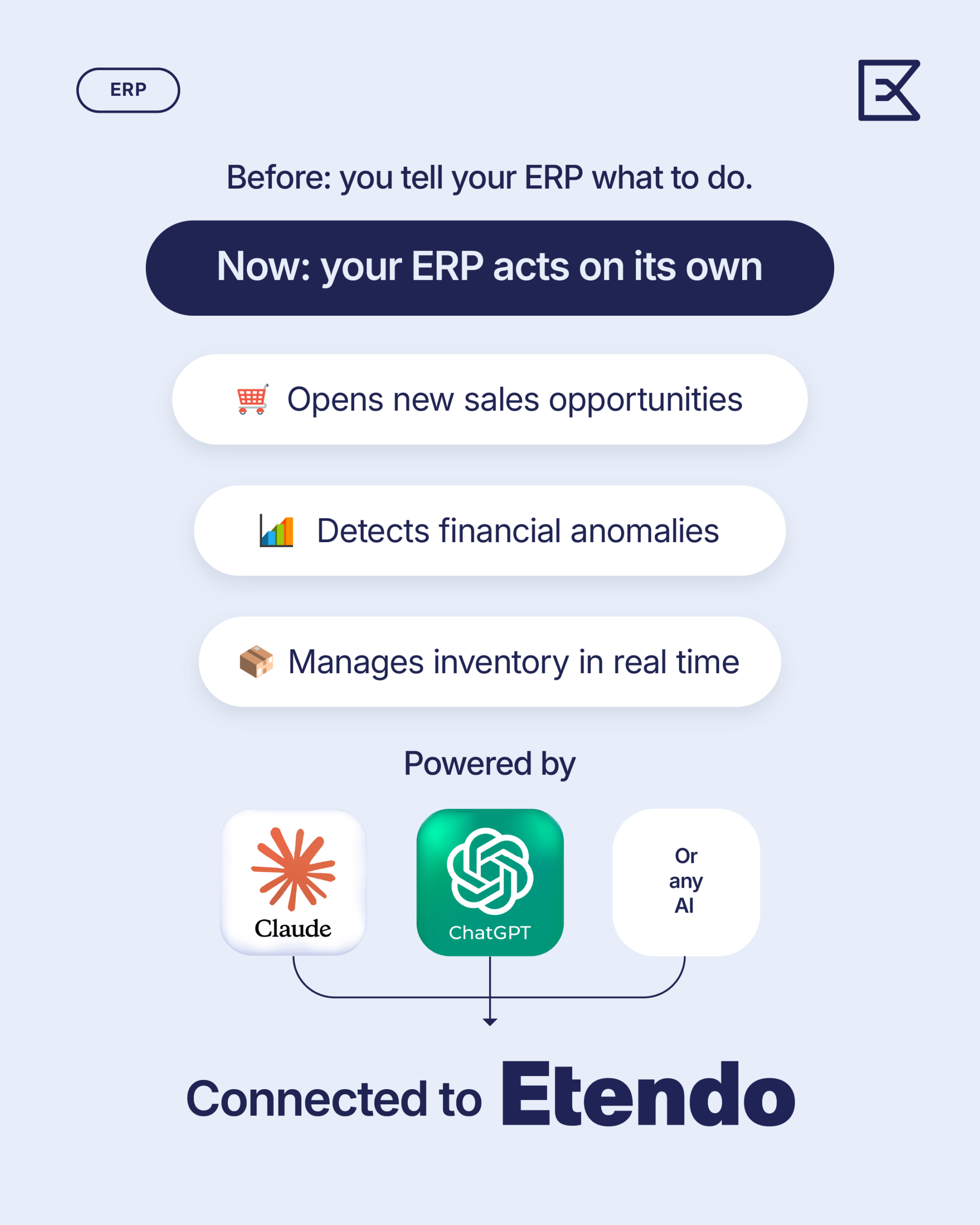
Think about how you use Claude, ChatGPT, or other AI assistants today. You give them context, assign tasks, connect external sources. Now imagine that, inside that same interface, Etendo appears as just another connector — the same way you connect Google Drive, your email, or your calendar.
However, that connector is not read-only. It is an active connection.
From your AI tool, you can train an agent to do exactly what an employee does today at the keyboard: log a sale, check an order, verify stock levels, process an invoice. With the same data, the same permissions, and the same audit trail as any human user.
Why does this matter? Because it eliminates the gap between AI reasoning and execution inside the system. Today, even if you use AI to analyse your business, acting on the ERP is still a manual step. With an agentic ERP like Etendo, that gap disappears. The AI does not just tell you what to do: it does it.
What changes for your team
The efficiency gain is not measured only in time saved. It is measured in the quality of decisions and in how fast the organisation can respond.
🛒 Sales scenario
A sales manager trains an agent to handle opportunity creation. When a request comes in, the agent analyses the customer profile, checks purchase history, verifies stock availability, and creates the record in the ERP. What used to take half an hour across several systems happens in seconds, with zero transcription errors.
In other words, the sales team does not disappear. Instead, they focus on closing, not on logging.
📊 Finance scenario
A CFO has an agent that monitors transactions in real time. When it detects an anomaly — a margin below threshold, an invoice that does not match the purchase order — the agent flags it proactively, with all the detail needed to make a decision. Without waiting for the monthly report.
The finance team does not cut meetings. They arrive better prepared.
Etendo is already on that path
There is an important difference between announcing the future of ERP and building it.
For instance, major vendors have spent years layering AI on top of their systems. In most cases, however, these are external additions — separate modules, integrations that take months, dependencies on proprietary infrastructure.
Etendo is building from the inside. The architecture already incorporates the protocol that allows any external AI tool to connect to the ERP securely, without custom development or complex credential management.
What already works today:
- Agents can query and operate in the system using natural language
- The connection with external AI tools is enabled with secure authentication
- The most direct workflows can already be executed autonomously
What’s coming:
- Greater autonomy for higher-complexity processes
- Specialised agents by business area
- End-to-end workflow management without human intervention at every step
Admittedly, the roadmap is honest — not everything is solved yet — but the direction is clear and the technical foundation is already in place.
FAQ about the agentic ERP
What is an agentic ERP and how does it differ from a traditional one?
A traditional ERP is reactive: it only acts when a user enters data or launches a process. An agentic ERP operates proactively — it observes, plans, acts, and verifies — without requiring intervention at every step. Tasks that today take hours of manual work can be compressed into seconds.
Can I connect Claude or ChatGPT to Etendo?
Yes. Etendo supports the standard protocol that allows external AI tools to connect to the ERP securely. From your preferred AI tool, you can add Etendo as a connector and train agents that operate in the system with the same data and permissions as a human user — with no custom development required.
Do AI agents replace employees?
No. The model that is emerging is one of mixed teams: humans and agents working together. Agents handle repetitive tasks and the execution of standardised processes. Humans focus on the decisions that require judgement, context, and relationships. The result is a more efficient team, not a smaller one.
Is this model only for large enterprises?
It is especially relevant for mid-sized companies. Large corporations have entire teams dedicated to integrating AI with their legacy systems — and it still takes them years. A company that starts from an ERP already built to be agentic gets access to the same paradigm at a fraction of the cost and time.
What is the risk of letting an agent operate in the ERP?
Agents operate within the permissions defined for each role — exactly like any human user. They cannot access data or execute actions that are not authorised. Every action is logged. Control stays with the human team: agents execute, but the rules are set by people.
Summary
The agentic ERP represents a paradigm shift in business management: the system stops being a passive repository and becomes an active participant in the business. Through connection with external AI tools, teams can train agents to execute in the ERP exactly what their employees do today — log sales, analyse transactions, manage stock, process invoices — with the same audit trail and permission controls, but at a speed and scale that manual work cannot match.
Etendo is building that architecture from the core of the system, not as an add-on module. Companies that adopt an agentic ERP now will not only gain operational efficiency: they will develop the capacity to work with mixed human-AI teams before it becomes the market standard. That time advantage, in an environment where decision speed is increasingly decisive, carries a value that goes far beyond any saving in hours.
You May Also Like
Still Creating Invoices Manually? Discover How Etendo 25.3 Automates Document Type Selection per Customer
https://youtu.be/fT0W0XfEw-Y Etendo 25.3: The Update That Eliminates Repetitive Tasks At Etendo, we

Gmail at Your Fingertips with Etendo Copilot: Seamless Productivity
https://youtu.be/YWsRS29hBZ4 In today’s fast-paced business world, efficiency and information cent
Ready for the Accounting Close? Discover Etendo’s Centralized Window for Not Posted Documents
Imagine closing an accounting period with the peace of mind of knowing that no document was left unp


Leave a Reply